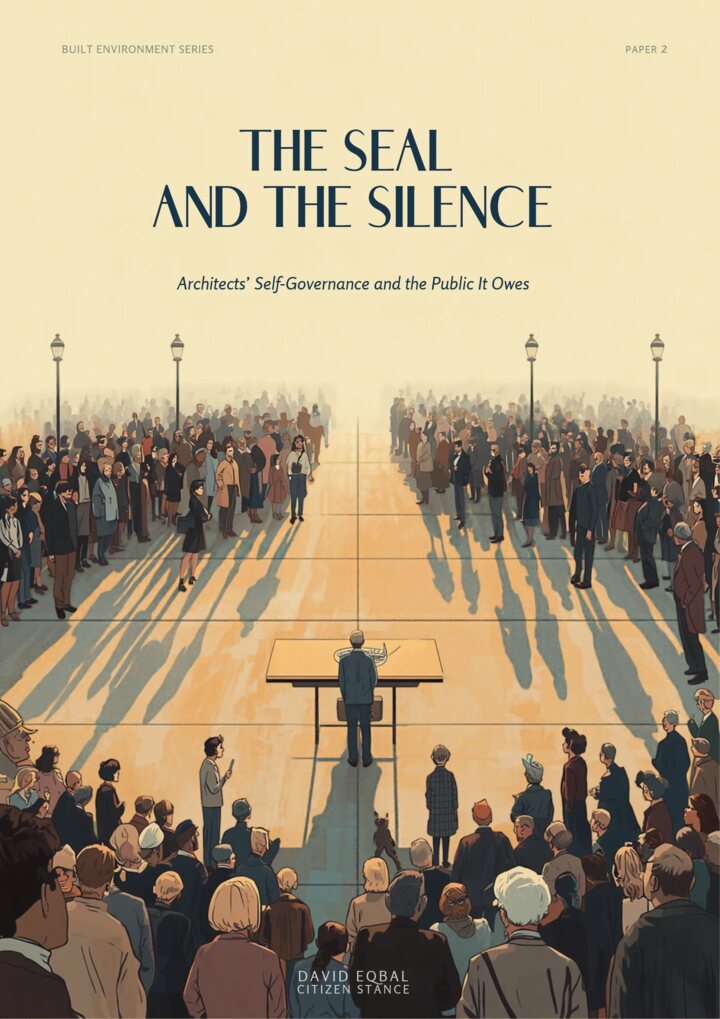
The Seal and the Silence
Architects' Self-Governance and the Public It Owes
In plain words
In Ontario, architects are licensed and overseen by their own professional body, the Ontario Association of Architects (OAA). This is called self-governance: the law lets a profession make and enforce its own rules, so that the public is "served and protected."
The paper studies the OAA's public record from 2013 to 2026. It finds that the OAA takes licensing seriously but reads its duty to the public narrowly. That matters to anyone who lives in a home. The rules at stake decide how much light and space our homes get.
The questions
- Does "the public interest" mean only protection from bad architects, or also good places to live?
- What did the OAA do, and not do, as the architect's job shrank to making buildings follow the rules? And why?
- What changes would give a real say to the people who live with its decisions?
The paper follows one architect, Claire Doucette, from the backyard gazebo she built at sixteen to her profession's annual meeting. Claire is invented. She is a mix of common experiences, not a portrait of a real person. The laws, fees, numbers and public statements in her story are real and cited.
What the paper finds
- Small rules shape homes before an architect is hired. In a Toronto example, a house can be no taller than ten metres, measured to the top of the roof. With other limits, this rewards flat roofs, lower ceilings and dim basement apartments. In Claire's invented story, a grandmother's basement apartment ends up with little light. The paper found no OAA public statement on rules like these.
- The OAA measured the cost of design review, not its value. Site plan review is the step where city staff check a building's design and layout before it can be built. The OAA paid for three studies of it. The latest, released in 2025, found it took twenty-three months on average and cost $3.5 billion a year. It said buildings of up to thirty homes should skip it. It also said an application should be approved automatically if the city misses its sixty-day deadline. None of the studies asked how the changes would affect the quality of buildings.
- Those numbers became the province's argument. In 2019, the OAA asked the province to limit what design review could look at, such as materials and window detail. In 2022, Bill 23, an Ontario housing law, exempted housing projects of ten homes or fewer from site plan review. It also stopped cities from regulating the "architectural details" of buildings. In March 2026 the province consulted on options that included ending site plan review, and it cited the twenty-three months.
- Members were not asked first. The paper found no step where the OAA asks its members before taking a public position. Votes at the annual meeting are "not binding on the Council," the OAA's elected governing board. At the end of 2024 Ontario had 5,053 licensed architects and about 2,000 interns (architects in training), who cannot vote. The OAA itself notes that fewer than 30% of members vote.
- One required insurer, owned by the OAA. Every Ontario architecture practice must buy its basic required insurance from one company, Pro-Demnity Insurance, which the OAA fully owns. The paper found no record that architects were asked about this in 1987, in 2003 or since. Past and current OAA leaders sit on its board.
- The OAA's stake has grown. Its investment in Pro-Demnity rose from about $28.7 million in 2019 to $55.8 million in 2024. That is almost four-fifths of everything the OAA owns. The paper found no record of any refund or credit to the architects who paid the premiums.
- Risk without a say. City reviewers can require changes to a design, but the architect carries the legal risk. Under Ontario law, someone found even partly at fault can be made to pay the whole bill if others cannot. Cities have lobbied to pay only their own share. The paper found no case of the OAA asking the same for architects.
- Other provinces do it differently. Quebec's architects' regulator spent forty years asking for an architecture policy, a government plan for good buildings and places. Quebec adopted one in 2022. British Columbia's architects must carry insurance but may buy it from any insurer. Alberta's architects voted on required insurance in 2020.
Why it happened
The paper tests six possible reasons. These include a narrow view of the OAA's job, fear of looking self-serving, and fear of losing self-governance. Others are a habit of counting only what is easy to count, and decisions made by a small group. The paper does not claim to know what any person intended. Its conclusion: better people would not fix this, but a better structure would.
What it proposes
- Two separate voices. The Council keeps licensing, standards and discipline, with its public members (people the province appoints). A new Architects' Assembly of every licensed architect and intern decides the OAA's public positions on buildings and places.
- A clear way to take public positions. Give notice, ask members and the public, weigh the effects, decide, and publish. Quality counts as well as cost and time. Major positions go to a vote, binding if at least a quarter of the Assembly takes part. A round takes about thirty days.
- A duty to the people in the building. Architects get a protected right to refuse instructions that would seriously harm the people who use a building. A "Register of Unintended Harm" lets them report rules that cause harm their authors never meant.
- Count what matters. Measure value as well as cost, and push for an Ontario architecture policy. Panels of qualified designers would replace the design part of city staff review, with fixed timelines.
- A say that matches the risk. Members vote on keeping the OAA-owned insurer or allowing a free choice, as in British Columbia. Policyholders elect most of the insurer's board. The OAA asks that each party pay only its own share of the blame.
- Checks from below. Interns get a vote. Annual meeting votes on public positions become binding. The public members can block one only by explaining in writing why it harms the public.
The paper asks the Council to put this plan, or a better one, to a vote within a year. It says it will accept the result if members reject it.
Why this matters to you
- The homes people live in. Small rules about height and roofs decide how much light and space a home gets. That includes a basement apartment for a parent.
- How new buildings look and fit. Design review is a check on the quality of what gets built on your street. The paper shows how it was narrowed, and how it could work better.
- Speed and quality together. Faster approvals matter. The paper's point is that time and money were measured, but quality was not.
- Who speaks for the public. A profession's right to govern itself is lent for the public's sake. The paper argues that architects, and the public, should be asked before positions are taken in their name.
What the paper does not claim
It credits what the OAA does well. It examines, licenses, insures and disciplines architects seriously. Its Council meets in public and publishes minutes, and it openly names its own low voter turnout. In 2019 it warned that moving plan review to private architects would raise their legal risk. In 2023 it called for gently adding homes to existing neighbourhoods. It also backed "Missing Middle" housing, such as townhouses and small apartment buildings.
The paper accepts that the delays were real and that site plan review was often done badly. It notes that the OAA cannot fix zoning, and that architects do not design most housing in Ontario. It relies only on the public record, so a record it did not find may still exist. The author says he is not neutral: he has worked in this system for twenty-five years.
How to cite
Eqbal, David (2026). The Seal and the Silence: Architects' Self-Governance and the Public It Owes. Citizen Stance / Position Citoyenne. SSRN. https://ssrn.com/abstract=7558299
This page is a summary. The full paper, with every source, is free to read on SSRN.