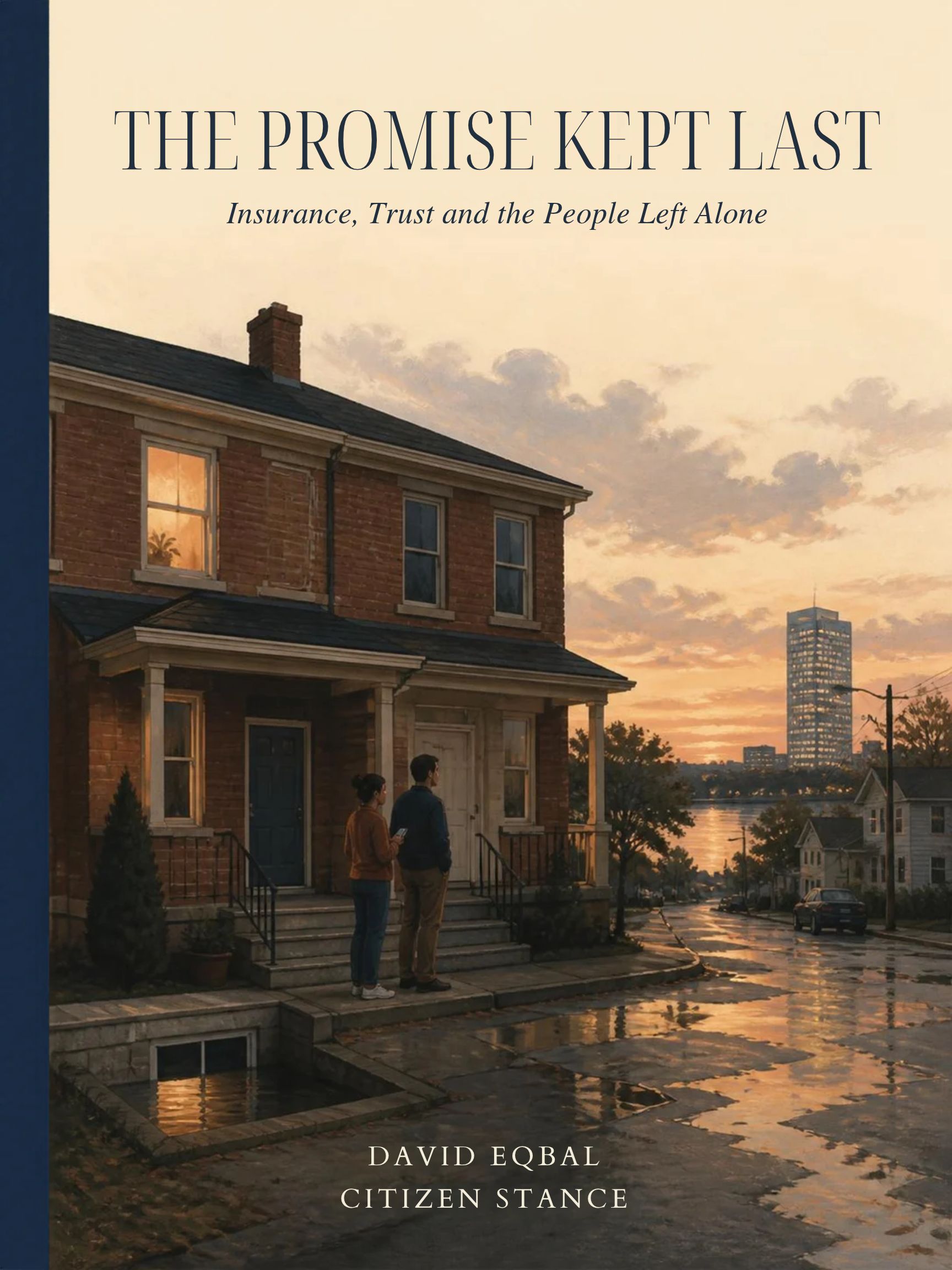
The Promise Kept Last
Insurance, Trust and the People Left Alone
Watch the video (9 min)
In plain words
Insurance is a promise. You pay for it every month, often for years, and it is tested only when something goes wrong. In Canada, the company that has to pay usually decides whether it owes you. This paper follows two invented households who learn this the hard way: the Morettis, whose basement floods, and Grace, who loses her disability income. It argues that people who claim need a fair referee, and that everyone should see how each insurer treats claims.
Two invented stories
The paper looks at home, car, life, health and disability insurance. It uses two made-up households, labelled as invented each time. Each step in their stories matches real cases.
- The Morettis (invented). A storm floods their finished basement, where Rosa's mother lives. Their policy has an add-on for sewer backup (water up the floor drain), but not for overland flood (water from outside). The insurer's engineer decides most of the water came through the windows. The insurer pays $11,400 of an $87,000 loss.
- Grace (invented). Grace is a bookkeeper with disability coverage through work. Many plans pay at first if you cannot do your own job. After about two years, you must show you cannot do any suitable job. At that point her payments stop, and she has no income while she appeals.
What the paper finds
- Canada checks that insurers can pay, not how they treat claims. Rules that make sure insurers have enough money are strong. Rules on how customers are treated rely mostly on guidance.
- The company that pays decides what it owes. The adjuster (the person who assesses the damage), the engineer or the examining doctor is chosen and paid by the insurer. The first appeal goes to the same company.
- The complaint services are paid by the industry. Canada has two free complaint services, called ombudsmen. Insurers fund both, and both can only make recommendations. New rules in April 2026 kept both features.
- Few complaints get a full review. In the year to March 2025, the life and health ombudsman received 1,470 complaints. Only 16 reached a full investigation.
- The numbers are hidden. Insurers in Ontario and Québec have reported complaint data to regulators since 2005. No regulator publishes how often each insurer denies claims, or how long each takes to pay.
- Court takes years. In Whiten v. Pilot Insurance, a family's house burned in 1994. The insurer claimed arson, against the views of the fire chief and its own adjuster. The Supreme Court ruled against the insurer in 2002.
- A few big companies. Ten groups sell about 59% of home, car and business insurance. Three companies hold about 67% of life and health insurance business.
- Gaps where risk is growing. About 1.5 million high-risk households cannot buy affordable flood coverage. A national flood program promised for April 2026 has not started.
Why this matters to you
- You claim when you are weakest. A flood or an injury leaves little time, money or energy to argue. The insurer handles thousands of claims a year.
- You cannot compare insurers on claims. You can compare prices, but not how often a company says no.
- Water damage is not all the same. Sewer backup and overland flood are often separate add-ons. With only one, you may be covered for one cause and not the other.
- Work disability plans can change at two years. Grace was never told. In many plans, the test changes after 24 months.
Why governments have been slow to act
The paper names six reasons:
- Rules built to protect the company. Regulation grew out of the fear that an insurer would go broke, not that a claim would be unfairly refused.
- The few against the many. The industry is organized. People who claim are scattered and meet the system once.
- Watchdogs paid by those they watch. Regulators and ombudsmen are funded by the industry.
- Too many doors. A federal agency, OSFI, checks that insurers can pay. Provincial agencies, such as Ontario's FSRA, oversee how customers are treated. Each can say the problem belongs to someone else.
- Backing down. Reforms get announced and dropped, like Ontario's public car insurance plan in 1991.
- A pillar of the economy. Insurers are among Canada's largest investors, so governments may hesitate. The paper calls this the least proven reason.
The four checks
Citizen Stance papers use a test from an earlier paper, Channels, Not Dams. Can a power be trusted even when the person holding it is just an ordinary person? The test has four checks. Here is how a claim measures up:
| Check | What exists | What is missing |
|---|---|---|
| Someone independent reviews the decision | Home policies can use outside "appraisal" to settle the dollar amount. Ontario car accident disputes go to a public tribunal. | For other claims, no one the insurer does not pay looks at the decision. |
| The facts are public | You can usually get the reasons and your file. | Public numbers for each insurer on denials and delays. |
| A way to complain and get an answer | The insurer's complaint office, the ombudsmen, the courts. | Real force. Ombudsman findings bind no one, and court takes years. |
| The people affected are heard | Nothing. | Any way for claimants' experiences to reach the public record. |
Should insurance companies exist?
Yes, because the job must be done. The paper compares three kinds of insurer: owned by shareholders, owned by policyholders (a "mutual"), or run by government. Shareholder ownership fits a claim worst, because every dollar not paid can go to the owners. But a new owner is not enough. Without the four checks, any kind of insurer can fail the people who claim.
What it proposes
Track A: make every insurer answer to the people who claim
- Publish the numbers. For every insurer, every year: denials and reasons, time to pay, complaints and reversals.
- Make delay cost the insurer. Deadlines in law, with interest added automatically.
- Independent review before court. Experts neither side chooses look at the dispute first.
- An ombudsman with teeth. Funded at arm's length, with decisions the insurer must follow if the claimant accepts them.
- Equal rights for workplace plans, and visible enforcement. People covered through work get their file and independent review. Insurers with bad patterns are fined and named.
- Claimants are heard. A public record of claimants' experience, and a consumer office at the regulator.
Track B: a Canadian Insurance Trust
- A public choice. A new public insurer competes with private companies but does not replace them. It sells a home policy that covers fire, sewer backup and overland flood together. It also sells disability coverage whose test does not change at two years without a new, independent check. Provinces may also join for basic car insurance.
- A backer for mutuals. The Trust gives start-up money and backup cover for huge losses (called reinsurance) to insurers owned by their policyholders. In return, they must meet the four checks, put claimants on the board, and never convert into shareholder companies.
What the paper does not claim
It does not say insurers act in bad faith, and many claims are paid fairly. It does not know how many claims are denied, or whether some kinds of insurer deny more. No published Canadian data says, and that gap is part of the argument. The Trust's cost has not been worked out yet.
If you have a claim
The paper ends with ten practical steps and a sample letter to elected officials. Some of the steps:
- Put everything in writing. Follow each call with a short email, and keep a dated log.
- Ask for your policy and your file. If refused, ask in writing for the reasons and the reports used.
- Record the loss yourself, and watch the deadlines. Keep photos and receipts. Some time limits are short.
- Ask for a final position letter. This is the insurer's last word in writing. In Ontario, you need it before the regulator will look at a complaint.
- Get independent advice early. Especially if the claim is large or complicated.
This is general information, not legal advice. Rules differ by province and by policy.
How to cite
Eqbal, David (2026). The Promise Kept Last: Insurance, Trust and the People Left Alone. Citizen Stance / Position Citoyenne. SSRN. https://ssrn.com/abstract=7643938
This page is a summary. The full paper, with every source, is free to read on SSRN.