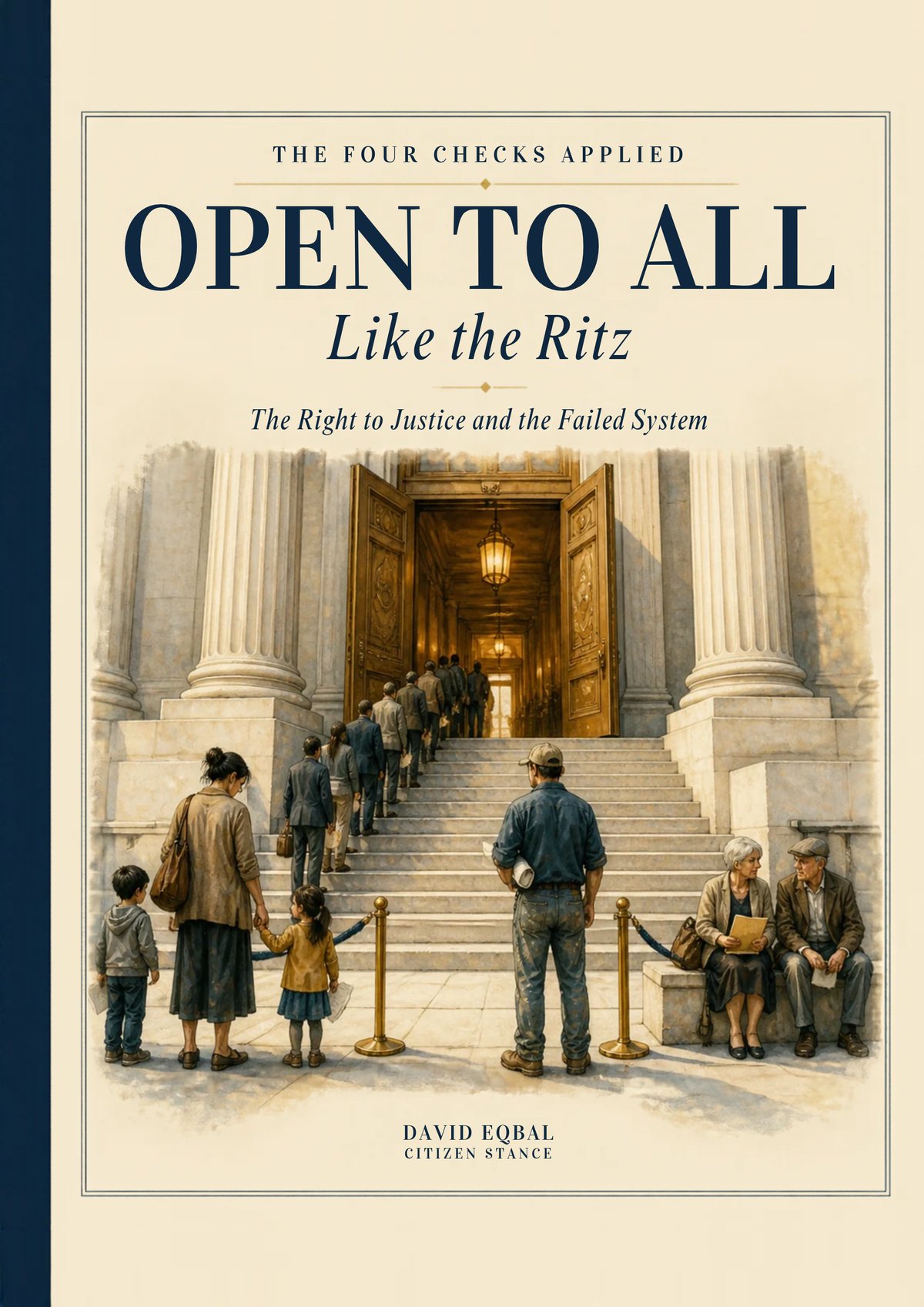
Open to All, Like the Ritz
The Right to Justice and the Failed System
Watch the video (9 min)
In plain words
An old saying goes that the Ritz Hotel is open to everyone: the door is open, but few can afford to walk in. This paper says Canada's courts are the same. Almost half of Canadian adults face a serious legal problem in any three years, but only about one in five gets legal advice, and fewer than one in ten reaches a court or tribunal. Many people believe the system is built so that lawyers get rich. The paper tests that belief and finds it wrong about the motive but right about the effect.
Four invented stories
The paper follows four made-up stories, labelled as invented each time. What happens in them matches what the reports, court data and rules describe.
- Marisol (invented), a dental hygienist and mother of two, separates from her husband. She pays a $10,000 lawyer's retainer from a line of credit. It is gone in five months, so she carries on alone, reading the Family Law Rules at night. Her husband still has a lawyer.
- Kwame (invented) runs a small renovation company. A homeowner refuses to pay the last $62,000. He can give up $12,000 to fit the Small Claims Court limit of $50,000, or sue in the Superior Court, which could take years and cost much of what he wins.
- Ruth and Stan (invented), in their seventies, rent out their basement. Their tenant loses his job and stops paying. They apply to the Landlord and Tenant Board and wait months for a hearing, and so does the worried tenant.
- Aisha (invented), a young lawyer in a downtown firm, must bill a set number of hours each year. She can see which steps a case does not need, but she cannot be the one to cut them.
What was promised
From Magna Carta's pledge not to sell, deny or delay justice, through the Charter and decisions of the Supreme Court of Canada, the promise is that justice will be:
- Reachable: people can get to it.
- Timely: it comes in time to matter.
- Understandable: people can follow it without a lawyer.
- Equal: the side with more money does not win just by lasting longer.
- Respectful: people are treated with dignity and told what is happening.
What the paper finds
- Lawyers cost too much for most people. In 2021 a contested divorce cost about $20,625 on average, and a five-day family trial about $43,481. Legal aid is only for the lowest incomes. Most people are in the "missing middle": earning too much for legal aid, too little for a lawyer.
- Cases take years. In Toronto a civil case can take four to five years to reach trial, and in 2023 simple motions were booked more than a year out. The Landlord and Tenant Board's caseload grew from under 14,000 before the pandemic to about 53,000.
- Many people go it alone. More than half of the people in Ontario family cases had no lawyer when they filed. Most said they could not afford one, and many are well educated and still lost.
- It costs everyone. Unresolved legal problems cost governments about $800 million a year in benefits and health care.
- The judges are not the problem. Cases that reach a judge are decided fairly. The failure is on the road to the courtroom.
Is it built for lawyers?
The paper gives both sides a fair hearing.
- The case for: judges and lawyers write the court rules, with no member of the public on either of Ontario's rules committees. Most cases are billed by the hour, so every extra step earns more. And the Law Society, which decides who else may give legal help, is run mainly by lawyers.
- The case against: most lawyers are not rich, and many who help ordinary families are poorly paid. The worst delays come from too few judges, courtrooms and staff, which governments decide. Much of the reform under way was led by lawyers and judges.
The verdict: no one designed the system to make lawyers rich. But it is built and run by insiders, so it drifts toward more steps, more time and more cost, and nothing from outside pushes back. The people who use the courts pay for every lever and hold none.
Measured against the promise
| Part of the promise | Kept? | Main reason |
|---|---|---|
| Reachable | No, for most people | Fees far beyond ordinary incomes; legal aid only for the poorest. |
| Timely | No | Years to a civil trial; no time standard for civil and family cases. |
| Understandable | No, without a lawyer | Rules written for professionals. |
| Equal | Not in practice | The side that can pay longer, or wait longer, has the stronger hand. |
| Respectful | Rarely | No one tells people how long they will wait, or is responsible for their whole case. |
Why this matters to you
- Almost anyone can end up here. A separation, an unpaid bill, a tenant or landlord problem: these are ordinary parts of life, not rare events.
- Delay is not neutral. While a case waits, the person with less money loses ground, and the other side can simply wait.
- No one tells you how long it will take. No court in Ontario publishes how long its cases take from start to finish, or what they cost the people in them.
The four checks
Citizen Stance papers use a test from an earlier paper, Channels, Not Dams. Can a power be trusted even when the person holding it is just an ordinary person? The test has four checks. Here they are applied to the justice system, never to how a judge decides a case:
| Check | What exists | What is missing |
|---|---|---|
| Someone independent reviews it | The Auditor General audits parts; the Ombudsman reviews tribunals but not the courts. | No body measures time, cost and results from the user's side. |
| The facts are public | Some tribunal numbers; partial national statistics. | A regular public report of wait times and costs. British Columbia shows it can be done. |
| A way to raise a warning and get an answer | Complaints about individual lawyers and judges. | A channel for delay, cost and complexity that must be answered. |
| The people affected are heard | Consultations; a few appointed lay members at the Law Society. | Any seat for users on the rules committees. |
What is already changing
Ontario is in the middle of real reforms. The Civil Rules Review proposes three tracks, fewer motions and a hearing within about two years for most cases. The Small Claims Court limit rose to $50,000 in October 2025. Digital courts started in Toronto the same month, and paralegals may now do some family law work. These are serious changes, mostly led by judges and lawyers. But they change the rules, not who makes them, none of them makes timely justice a right, and the larger rule changes have no date yet.
What it proposes
- An Access to Justice Act. A law that makes civil and family justice that is reachable, timely, understandable, equal and respectful a right, with published time limits for every court and tribunal.
- Delay costs the system, not you. When a court or tribunal misses its time limits, the cases it delayed get priority and fee waivers, and the Attorney General must table a plan within 45 days.
- A Justice Access Office. An independent office reporting to the Legislature that publishes, every three months, how long people wait and what cases cost at every courthouse and tribunal. Its recommendations must be answered in public within 45 days. It would never comment on a judge's decision.
- Users at the table. At least a third of the seats on the rules committees for members of the public, including people who have been through a case.
- Help for working people. Family legal aid tied to what a contested case really costs, and free advice at every first family court appearance.
- Quick answers to simple questions. Temporary child support set on documents before the first court meeting, and an online tribunal for small debts and unpaid rent, like British Columbia's.
- Finish the reforms, with dates. Complete the Civil Rules Review on a published schedule, fill judge vacancies quickly, and have the Law Society report each year on what it does to improve access to justice.
What the paper does not claim
It does not say judges are unfair or lawyers are dishonest. It does not propose any change to the independence of judges, or of the legal profession from government. It does not say money alone, or new rules alone, would solve the problem. The author is not a lawyer. Its claim is narrower: a system that every Canadian's rights depend on should be measured from the side of the people who use it, and should answer to them.
What you can do
The paper ends with practical steps for people facing a family case, a money dispute or a tribunal hearing, and a sample letter to elected officials. Some of the steps:
- Watch the deadlines. Most civil claims in Ontario must start within two years. Some deadlines are much shorter, like the sixty days a contractor has to preserve a construction lien.
- Get a free first opinion. The Law Society Referral Service (findlegalhelp.ca) offers a free consultation of up to thirty minutes. Steps to Justice (stepstojustice.ca) explains common legal problems in plain language.
- Facing a family case? Start at the Family Law Information Centre in your courthouse, and ask about free and low-cost mediation where it is safe.
- Owed money? The Small Claims Court now hears claims up to $50,000 and is simpler, faster and cheaper.
- Hiring a lawyer? Ask for a written estimate for the whole case and each stage, and ask to be told before it is exceeded.
This is general information, not legal advice. Services and rules change; check them before you rely on them.
How to cite
Eqbal, David (2026). Open to All, Like the Ritz: The Right to Justice and the Failed System. Citizen Stance / Position Citoyenne. SSRN. https://ssrn.com/abstract=7672380
This page is a summary. The full paper, with every source, is free to read on SSRN.