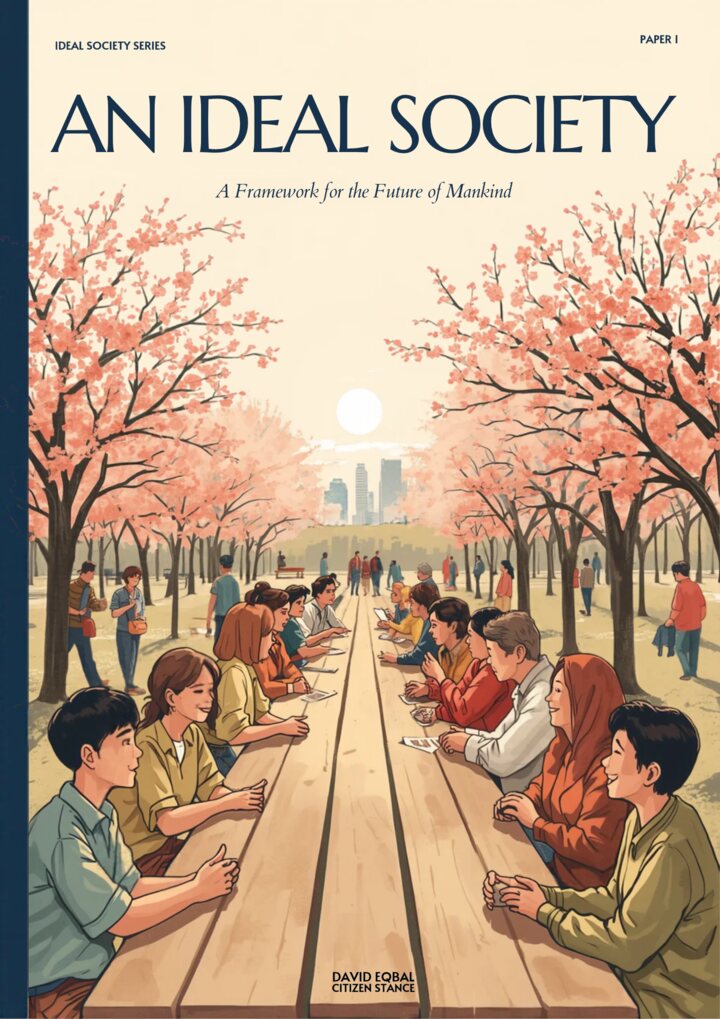
An Ideal Society
A Framework for the Future of Mankind
In plain words
All through history, the same story repeats. Power gathers in a few hands, chances in life shrink, and institutions built for everyone end up serving those closest to them. The author, an architect, argues that this is not a mystery. It happens because societies are designed as if people will be better than they are. His answer is to treat the human drive for power and gain like gravity: something to design around, not wish away. In his words, the goal is "not to dam the river, but to dig the channels."
What the paper is about
This is the first paper of the Ideal Society Series. It sets out four core values, which it calls "pillars," and four areas of society that must carry them. It offers a test for respecting other cultures without excusing abuse of power, and pictures daily life in such a society. The paper calls itself a framework, meaning a set of guiding ideas, not a detailed plan.
The argument
- The pattern. Early communities were cooperative. As they built up extra food, land and trade, the big question became who controls it. Those who had power took more. In the paper's words: "Wealth bought influence. Influence rewrote the rules. The rules protected wealth."
- The modern version. Democracy was a real achievement, but it can be captured too. Courts favour those who can pay for good lawyers. The family and place you are born into still shape your life more than almost anything else.
- The cause. Self-interest means wanting security, comfort, status and control. It is not shameful, and it kept our ancestors alive. But without limits built into the system, it reshapes the very rules meant to hold it back.
- Three answers that fall short. Making people good fails because, sooner or later, someone without virtue will lead. Banning self-interest just hands power to those doing the banning. Leaving self-interest alone lets it grow unchecked. Each holds some truth, but none is enough.
- Design around human nature. The better question is how to build a society where self-interest still leads to good results for everyone. So no one should hold unchecked power, and ambition should be channelled, not crushed.
The four pillars
| Pillar (core value) | The question it answers | What it means in practice |
|---|---|---|
| Channelling power and gain | What do we do with the drive for power and gain? | Power changes hands, people in charge truly answer for their actions, and the economy rewards what people contribute, not only past advantage. |
| Equal opportunity | Where does a person's life begin? | Not equal results. But the family or place you are born into should not decide what your life can become. |
| Equal dignity | What is every person owed just for being human? | Dignity is not earned. It is built into how institutions work, not left as a nice idea. |
| Freedom rooted in each culture | What does freedom look like, and who decides? | Each civilization's own idea of freedom is respected, as long as it keeps dignity and opportunity for all. |
The pillars hold each other up. Without the first, the paper warns, the others become "fine words inscribed on the walls" of a system that ignores them. Together, dignity and opportunity set a floor: a level no one falls below. Above it, each person is free to shape their own life. A society that gave both but forced everyone into one mould would only build "a more comfortable cage."
Four areas of society
- Governance (how a society is run). Power is spread across bodies that check each other. Leaders serve limited terms. Decisions are explained in public, in plain language. Courts, the press and community groups stay independent.
- The economy. Markets are "a tool, not a philosophy," the paper says. They work well, but their gains pile up with those who already have the most. So good schools, health care, legal help and the basics of a decent life are a shared promise. Huge fortunes are treated as a policy choice, because economic power turns into political power.
- Education. Schools have three jobs: help each person grow, pass on the culture's own story, and prepare citizens to think critically about power. This is not about telling people what to think.
- Civic culture (the habits of community life). Taking part is valued. Teachers, builders, caregivers, farmers and nurses get fair pay and real respect. People think about the long term.
The four areas work as one system. The aim is not something perfect that lasts forever. It is something that can repair itself when it is damaged.
One framework, many cultures
The paper rejects the idea that one model fits every country, especially when it is pushed on others by pressure. Some things are shared by all: dignity, opportunity, keeping power in check and holding leaders to account. How people live these out, through family, community and ceremony, differs. The paper sees that variety as a strength.
One question ties it together: "Who benefits from this arrangement, and who does not?" A custom passes if the honest answer is the people as a whole. It fails if the answer is those who already hold power. The paper adds a second test: would the custom survive if the people living under it had a real choice?
A life inside it
To make this concrete, the paper follows an imagined girl (not a real person) through her life. The neighbourhood she is born in does not decide the quality of her school. She learns to think, and to understand how power is held to account. Her effort, not her family's connections, mostly decides how far she goes. She takes part in local decisions and disagrees with others without hatred. Her aging parents are not abandoned. She is not rich, but she has "a life that feels like it belongs to her."
Why this matters to you
- Your child's school. In the paper's design, the neighbourhood you live in should not decide how good your child's school is.
- Your chances in life. Effort and skill, not who your family knows, should decide how far you go.
- Services you rely on. Education, health care and legal help are treated as a shared promise, not left to the market alone.
- The work that keeps life going. Teachers, caregivers, farmers and nurses should be honoured with fair pay, not just kind words.
What it proposes
The paper ends with a call to "builders" of every kind. That means lawmakers, officials, judges and teachers. It also means anyone who teaches a child, runs a business, designs a building or helps run any shared group. It asks them to tell the truth about power, "including your own," and to build checks that limit even themselves. It asks them to invest in opportunity even when the payoff takes generations, and to respect other cultures. A good society, the paper says, is built "one honest decision at a time," and must be looked after like health.
Limits and open questions
The author says plainly that this is "not an academic paper." It is a short guide: "not a guarantee, not a blueprint for paradise, but a framework." It names principles, not specific laws or programs. It admits that a government built this way will still make mistakes, get stuck and have leaders who disappoint. It also admits that the line between real tradition and culture used to protect the powerful "is not always easy to draw."
Later papers in the series build on this one. The main paper, Channels, Not Dams, replaces the fourth pillar. It argues that the "who benefits?" test leaves the verdict to outsiders. In its place it puts "verified self-authorship": the people bound by a rule must be able to see it as their own, and check that for themselves.
How to cite
Eqbal, David (2026). An Ideal Society: A Framework for the Future of Mankind. Citizen Stance / Position Citoyenne. SSRN. https://ssrn.com/abstract=7422898
This page is a summary. The full paper, with its figures and bibliography, is free to read on SSRN.