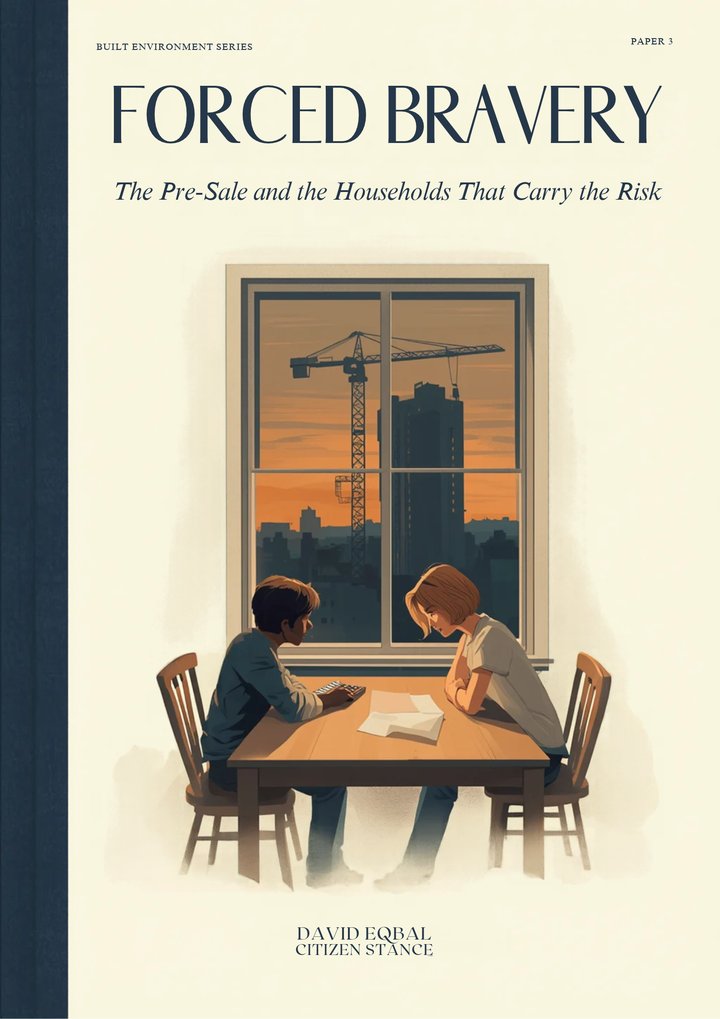
Forced Bravery
The Pre-Sale and the Households That Carry the Risk
In plain words
In Ontario, most new condos are sold years before they are built. Buyers sign a firm contract and hand over a large deposit long before they get the keys. If prices fall while they wait, the buyer carries the loss. The paper shows this through an invented couple, Leila and Tom Hartley, who suddenly must find $112,000 in cash. It proposes another way: future neighbours team up to build their own homes at cost, with public help.
The questions
- Who set up the system of selling condos before they are built, and why does the risk land on buyers?
- What happened when buyers stopped signing?
- Can homes be built without forcing anyone to gamble on someone else's schedule?
The Hartleys' story (invented)
Leila and Tom Hartley do not exist, and the paper says so each time. Every figure in their story is in the range of real cases in the press and the courts.
In 2021 they sign for a two-bedroom condo that is still a hole in the ground. They agree to $780,000 and pay a 20 percent deposit of $156,000. In 2026 the bank sends an appraiser, a person who estimates what a home is worth today. The appraiser says $640,000.
The bank will lend 80 percent of that, or $512,000. But on closing day, when the sale is completed, the builder expects $624,000. That leaves $112,000 to find in cash. If they walk away, the builder keeps their deposit and may sue for more. They did nothing wrong.
What the paper finds
- Buyers are asked to go first. Lenders usually want about 70 percent of units sold before they release a loan to build. A buyer's signature helps the builder get that loan.
- Bank rules reward contracts that are hard to leave. OSFI, the federal agency that oversees banks, makes building loans cheaper for banks when more units are sold. But a sale only counts if the buyer loses a large deposit by walking away.
- Real buyers face the same gap. One Toronto buyer paid a $439,000 deposit on a $2.195 million unit. It was valued at $1.6 million, and he gave up his deposit. Another faced a $120,000 gap in 2026.
- Courts hold buyers to the contract. In a 2024 Ontario case, Mattamy v. Ishola, a buyer who could not close was ordered to pay the builder about $87,700 on top of the lost deposit. A drop in value is not, on its own, a legal excuse.
- Buyers stopped signing. New condo sales in Toronto and Hamilton in early 2024 were the lowest since 1997. In 2026, builders in British Columbia asked banks to require fewer sales.
- Private lenders fill the gap, at a price. In 2024, lenders other than banks made one in six mortgages in the Toronto area. Their rates run about 8 to 15 percent a year, plus fees. In one regulator review, 42 of 82 short-term loans charged over 35 percent a year. That was before 35 percent became the criminal limit in 2025.
- The wait is heavy. A basket of everyday groceries tracked by Citizen Stance rose 37.9 percent from 2021 to May 2026.
- Money stress and health. Studies link money stress and falling behind on a mortgage to depression, skipped meals and medicine, and heart disease. No study has followed condo buyers in the months before closing.
Why this matters to you
- The price is fixed in one direction only. If you buy before a condo is built, your price will not go up. It will not come down either, even if the market falls.
- Your bank lends on today's value. If the home is worth less at closing, you must cover the difference yourself.
- Walking away can cost more than your deposit. A builder can keep the deposit and sue for its losses.
- The waiting years are not free. Rent and groceries can rise while your payment schedule stays the same.
What it proposes
An earlier paper proposed the Canadian Affordable Housing Trust, a non-profit public builder. In Model 1, the Trust builds on land owned by government. This paper keeps that and adds Model 2: resident building groups.
The idea comes from Germany, where it is called a Baugemeinschaft, or building group. Future neighbours form a group, buy a site, hire an architect and build for themselves at cost, with no developer's profit. German sources put the saving at about 15 percent, more in big cities. In Canada, one group in Langley, British Columbia, took about ten years, because it had to figure everything out alone.
How the Trust would help
- A place to start. A public list to match families, trained guides, and ready-made contracts.
- Money for the risky first year. Small loans to test a site and start the design.
- A backstop for the building loan. The Trust guarantees the group's loan, so each member's mortgage is approved at the start.
- A shared safety fund. A pooled reserve behind each group's own emergency fund of about 10 percent.
- A promise in return. Homes sell at cost, and resale gains are limited to inflation.
Six changes in the law, none needing public land
- A legal form for a member-owned building company, where each member is responsible only for their own home.
- Treating the group as building for its own use, with the new-home warranty (Tarion) through a licensed builder.
- An exemption, with conditions, from the rules for selling investments.
- Land transfer tax charged once, on the land only.
- Bank rules that treat a building fully committed to its members as being as safe as one 75 percent sold.
- Fast approvals for mid-size buildings, and city building fees (development charges) delayed until move-in.
Groups would build 20 to 35 homes at a time, in townhouses or four- to six-storey buildings. The paper estimates three to four years from first meeting to moving in.
The two models side by side
| Model 1: the Trust builds | Model 2: residents build, the Trust helps | |
|---|---|---|
| Land | Government land, at a token price | Private land, bought by the group |
| Who builds and designs | The Trust, with a residents' design group | The residents, with their architect |
| Trust money at risk | Money to build | Early loans, a loan guarantee and a shared reserve |
| Price | At cost | At cost |
| Resale | Gains limited to inflation | Gains limited to inflation, if Trust help is used |
| Best for | Large sites where public land exists | Main streets and small lots, where it does not |
The other road
The paper ends by imagining the same invented couple in a building group. Their home costs $663,000 to build, and they pay in stages as the walls go up. If costs run over, the members decide together what to change.
In 2026 a similar unit is valued at about $640,000, so on paper their home is worth less than it cost. A building group does not remove that risk. But no closing letter arrives. The risk is shared, visible and chosen.
Limits and open questions
The health studies mostly come from the United States. They show a link, not proof of cause. The paper found no documented case of a buyer ruined by a private loan taken to close. It does not claim any particular loan is illegal.
Building groups are not for everyone. They take time, meetings and trust, and some fail. The author, an architect, declares an interest: architects often start these groups.
How to cite
Eqbal, David (2026). Forced Bravery: The Pre-Sale and the Households That Carry the Risk. Citizen Stance / Position Citoyenne. SSRN. https://ssrn.com/abstract=7590698
This page is a summary. The full paper, with every source, is free to read on SSRN.