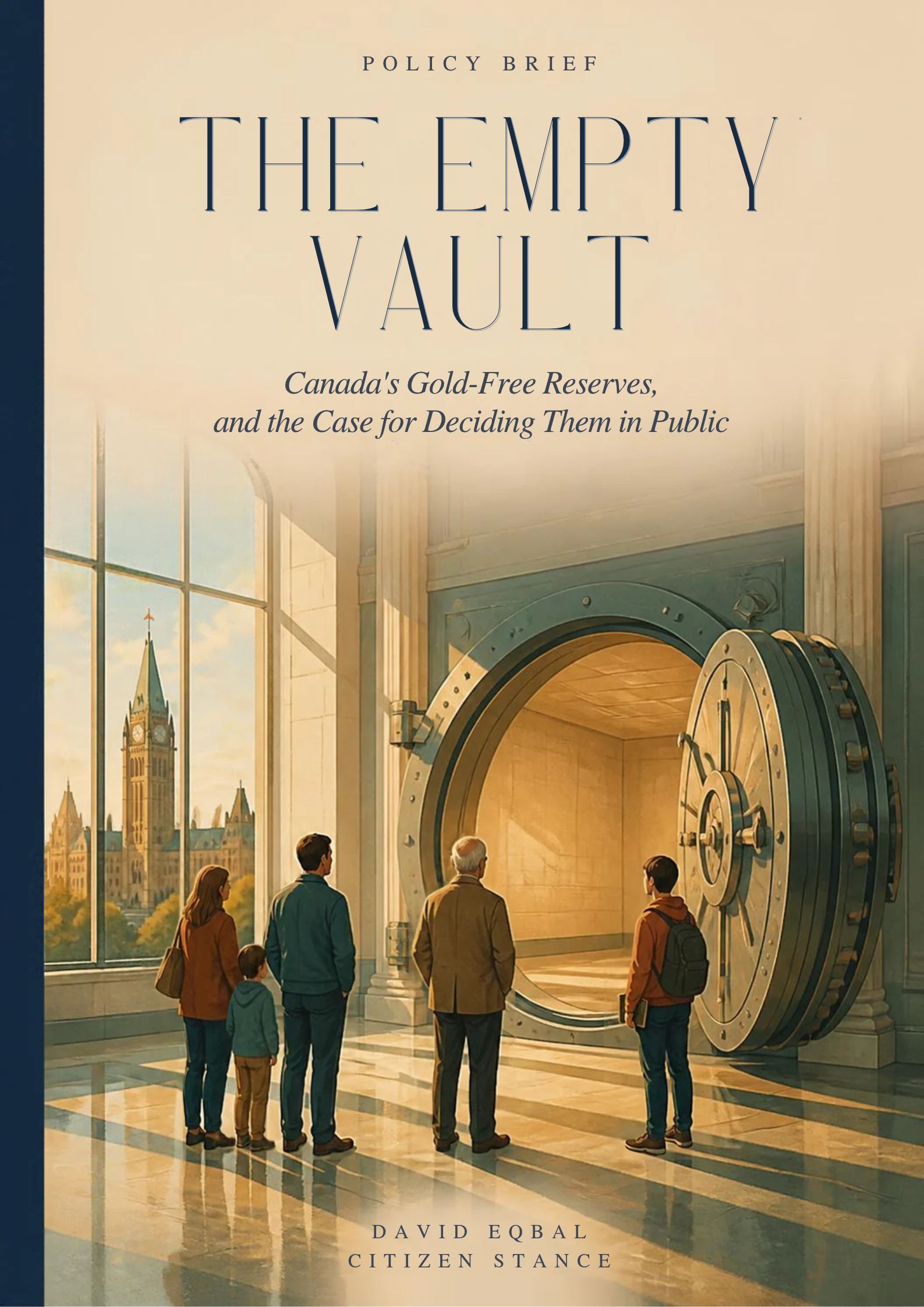
The Empty Vault
Canada's Gold-Free Reserves, and the Case for Deciding Them in Public
In plain words
Canada keeps a national savings fund in foreign money, called its official reserves. It exists to protect the Canadian dollar and to give the government cash in a crisis. Canada holds no gold in it, unlike every other G7 country (the seven largest wealthy democracies). The brief does not argue that Canada should buy gold, and says Canada's choice may well be right. Its point is simpler: a choice about this much public money has never been explained, costed or debated in public.
The question
Citizen Stance papers ask not only whether a decision is right. They also ask whether it was made in a way people can trust. For Canada's reserves, one person, the federal Minister of Finance, sets the policy. Parliament has never voted on it. No public estimate of what gold would cost has ever been published.
What the brief finds
- Canada holds no gold. On 15 October 2026, the reserves were worth US$126.1 billion, and the gold line was zero. In March 2025, about seven in ten of the easy-to-sell reserve dollars were US dollars.
- It once held a lot. Canada once held 1,023 tonnes of gold, and sold the last of it in 2016. At October 2026 prices, that gold would be worth about US$136 billion, more than all of today's reserves. The brief calls this hindsight, not policy, but it shows the size of the question.
- The world went the other way. Central banks are the public banks that manage a country's money. They bought more than 1,000 tonnes of gold a year from 2022 to 2024. After Russia's savings held abroad were frozen in 2022, many began to ask who could freeze theirs.
- A gold producer with no gold. Canada is the world's fourth-largest gold producer, at about 200 tonnes a year.
- Canada's reasons are real. Canada borrows the money it keeps in reserve. It matches each holding against a debt in the same currency, due at the same time. Gold pays no interest and has no end date, so it does not fit. The rules also put easy access to cash and safety first.
- The dollar floats. The market sets the Canadian dollar's value, and Canada has not stepped in to support it since 1998.
- Holding none is a choice. The government's current investment rules, dated August 2026, allow gold.
Why this matters to you
- It is public money. The reserves belong to Canadians, and so do the risks. Yet Canadians have no voice in how they are held.
- Most of it is in one currency. About seven in ten easy-to-sell reserve dollars are US dollars. That is the currency of the country now putting tariffs on Canada.
- You cannot see the reasons. The numbers are published, but not why the reserves are held this way, or what else was considered.
The case, both ways
For a small amount of gold: it would spread risk in savings now held mostly in one currency. It does not depend on any other country or bank keeping its promises. It also tends to hold its value in the kind of crisis reserves exist for.
Against: gold prices jump around, and buying near record prices is risky. Gold pays nothing, and because the reserves are borrowed, holding it has an ongoing cost. Canada's real protection comes from a floating dollar, strong markets and sound public finances. Norway also holds no gold.
Here is the brief's own rough estimate. It uses October 2026 prices and assumes the investments gold would replace earn about 4 percent a year.
| Share of reserves in gold | Value | Tonnes | Interest given up each year | Gain or loss if gold prices move 20% |
|---|---|---|---|---|
| 3% | About US$2.9 billion | About 22 | About US$115 million | About US$0.6 billion |
| 5% | About US$4.8 billion | About 36 | About US$190 million | About US$1.0 billion |
These figures are only an illustration. A published federal estimate would replace them, but none exists.
The four checks
The brief uses a test from an earlier Citizen Stance paper, Channels, Not Dams. It asks whether a public decision has four protections. Here is what it finds:
| Check | What exists | What is missing |
|---|---|---|
| Someone independent reviews the decision | Yearly reports. The Auditor General, Parliament's independent auditor, can review them. | No independent study of whether to hold gold, and no published cost estimate. |
| The reasons are public | Weekly and monthly figures, a yearly report and the investment rules. | The reasons for the current mix, and the other options considered. |
| A way to raise concerns and get an answer | Anyone may write to the minister. | A process that requires a reasoned answer. |
| The people affected are heard | Nothing. | Any voice for Canadians, whose money and risk these are. |
The reports that exist go up to the minister, not out to the public. No one checks the person who sets the policy. The decision may be right. It has never had to show that it is.
What it recommends
- A public review. The Minister of Finance publishes a review of what the reserves hold, including gold. It sets out the options, such as no change, a small amount, or gradual buying. It explains their costs, their risks and the reasons for the choice.
- Show where the money sits. Publish how much is held in each currency and with whom. Test how the reserves would hold up if one country blocked access to them.
- An independent cost check. Parliament asks the Parliamentary Budget Officer, its independent budget expert, to cost the options. The House of Commons finance committee holds a hearing.
- Repeat every five years. Time the review with the Bank of Canada's five-year inflation agreement, and present it to Parliament.
- Answer concerns in writing. Formal concerns from Parliament, the Budget Officer or the Auditor General get a written answer within a set time.
- Explain it plainly. Whatever is decided is explained in plain language.
What the brief does not claim
It does not recommend buying gold, or not buying it. It is not investment advice, and the cost figures are the author's rough estimates. Its only claim is this. Most central banks are changing course. So a decision about the safety of Canada's public reserves should pass the same four checks as any public power.
For students
A companion invitation on OSF, an open research website, offers nine questions for graduate students and other researchers. Examples: why Canada sold its gold, what holding some gold would really cost, and whether gold would have helped in past currency scares. Another asks what Canadians know and want.
A search in October 2026 found no academic study of Canada's own decision. There is no application and no fee, and work that disagrees with the brief is just as welcome. Citizen Stance offers no funding or supervision. With the author's permission, finished work will be listed beside the brief.
How to cite
Eqbal, David (2026). The Empty Vault: Canada's Gold-Free Reserves, and the Case for Deciding Them in Public. Policy brief. Citizen Stance / Position Citoyenne. OSF. https://doi.org/10.17605/OSF.IO/UT827
This page is a summary. The full brief, with its sources, is free to read.