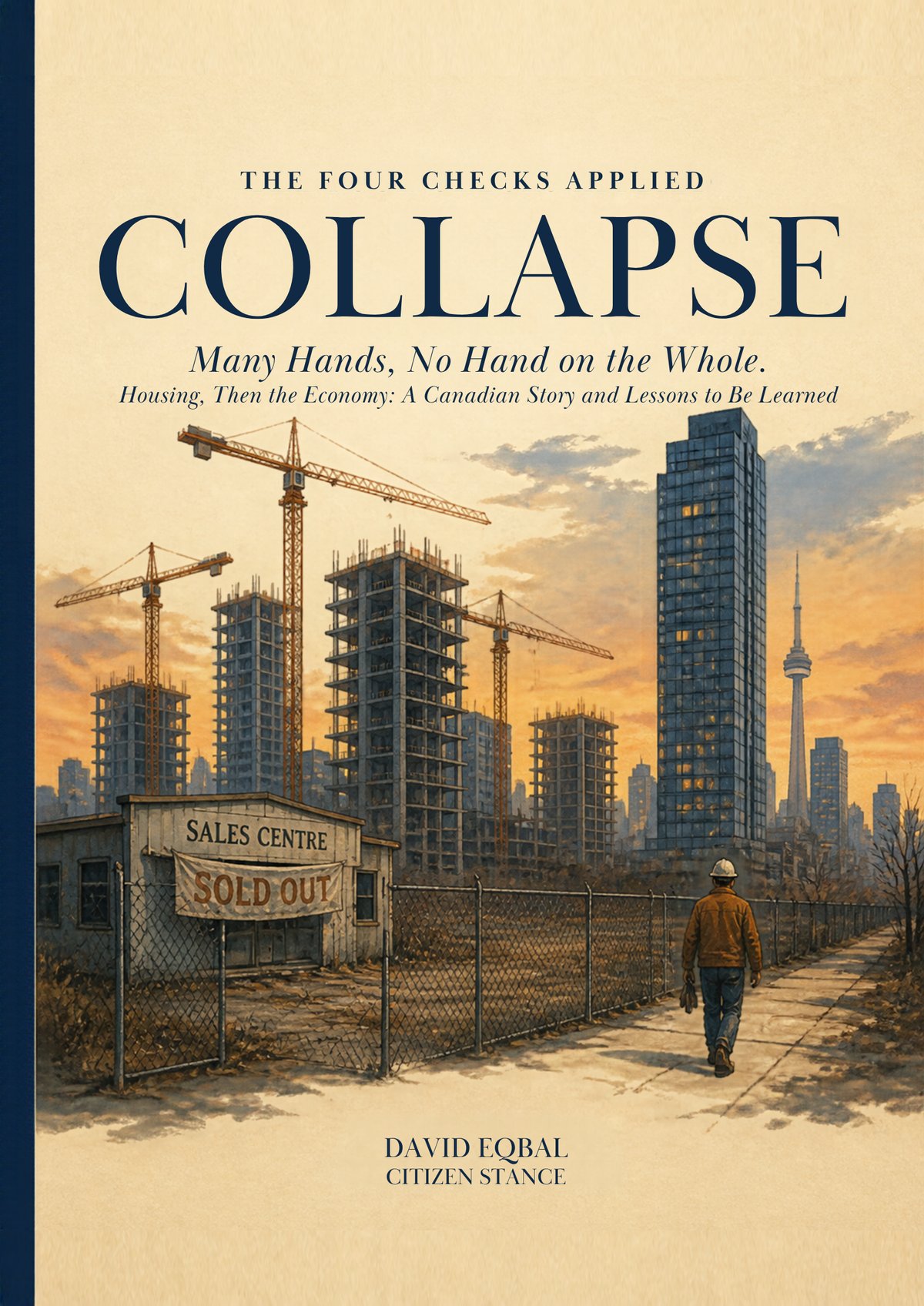
Collapse
Many Hands, No Hand on the Whole. Housing, Then the Economy: A Canadian Story and Lessons to Be Learned
Watch the video (8 min)
In plain words
Canada needs more homes, yet in 2025 the Toronto region almost stopped building them. New home sales were the lowest in 45 years. This paper asks why. Its answer is that many different bodies each changed one thing, often for good reasons, and no one had the job of asking what all those changes would do together. It calls this "many hands, and no hand on the whole," and it proposes a public office to do that job.
Five invented people
The paper follows five made-up people, labelled as invented each time. What happens to them matches what the reports and data describe.
- Priya (invented), a nurse, buys a condo in 2021 before it is built, for $620,000. She pays a $124,000 deposit. When the building is finished in 2025, the bank values it at $480,000. To close the purchase, she would need more than $100,000 she does not have.
- Tomás (invented), a carpenter who builds the forms for concrete towers, finishes his last tower in 2025. There is no next one. He is laid off, and his mortgage renews that fall.
- Frank (invented), a small builder in Hamilton, waits three years for approval to build twelve townhouses. By then his loan costs have doubled. In two years he sells four.
- Nadia (invented) runs a kitchen and tile supply business. When builders stop selling, her orders stop. One builder goes under owing her money, and she lets seven people go.
- Hannah and Jordan (invented) rent in Toronto and save for a home. Their rent rises by nearly a fifth. Then Jordan's shift is cut because of the trade war with the United States.
None of them was reckless. Each was hurt by decisions someone else made.
What happened, 2020 to 2026
- The boom. In 2020 the Bank of Canada cut its interest rate almost to zero and kept it there for two years. Home prices hit a record in early 2022. Investors bought most new condos in the Toronto region, by some counts 70% or more, so condos were built small to suit them.
- The turn. From March 2022 the Bank raised its rate ten times in sixteen months, from 0.25% to 5%. Building costs had also risen sharply.
- The surge. Canada added 1.27 million people in 2023, the fastest growth since 1957. Most were temporary residents, such as international students and workers. Rents climbed.
- The reversal. From 2024 Ottawa cut the number of temporary residents, sharply and quickly. The renters the small condos were built for left just as a near-record number of those condos were finished.
- The bust. In January 2026 only 85 new condos sold in the whole Toronto region. Builders cancelled a record 7,243 units in 2025. About 3,000 buyers could not close, and Toronto lost 34,600 construction jobs from their peak.
- A second shock. United States tariffs from March 2025 hit factories and exports. The economy shrank in late 2025 and early 2026, mainly because of trade.
What the paper finds
Seven levers shaped the housing market, and a different body held each one: interest rates, immigration, mortgage rules, taxes and charges on new homes, building approvals, the way new condos are paid for, and an economy that leans on housing. Taken one at a time, almost every decision can be defended. The harm came from the way they met.
- Two clocks. A home takes four to six years to build. Interest rates and immigration can change in months. The towers finished in 2025 were built for the buyers of 2021. Homes due in 2030 are not being sold now, so they will not be built.
- Everything at once. In the boom, every lever pushed demand up. In the bust, every lever turned the other way together.
- The squeeze. Most new condos are sold before they are built (a "pre-sale"), at a price fixed years ahead. Costs, interest and city charges rose while those prices stayed fixed. Then, at the end, banks valued many units below the price buyers had agreed to pay.
- Bad timing. The biggest drop in temporary residents came in 2025, the same year the most new condos were finished. Parliament's own budget watchdog had warned that the government's plans were at "significant risk."
- It did not stay in housing. Canada's economy depends on housing more than almost any other rich country's. The damage spread to the trades, suppliers, household debt, city budgets and young people.
Who is responsible
"No hand on the whole" does not mean no one is to blame. Each body could see beyond its own lever, and most saw the danger. The paper gives each one a graded share. These are judgments, not measurements, and they belong to offices, not to individual people.
| Who | What it could have seen | Share |
|---|---|---|
| The federal government (immigration and Finance) | Let temporary residents surge with no published target, then cut sharply just as the most homes were finished. | Major |
| The Bank of Canada | Buyers heard its promise that rates would stay low as a reason to commit to homes years away. | Major |
| Cities and the province | Raised development charges (fees on new homes) by half in one year as the market turned, and left approvals slow. | Significant |
| Developers and lenders | Knew the investor condo depended on rising prices and population, and that buyers carried the risk. | Significant |
| Mortgage regulators and investors | Tested buyers when they signed, not when they had to close years later. Investors bought expecting prices to keep rising. | Contributing |
| Governments over decades | Made housing the favoured place for Canadians to put their savings. | Underlying |
Why this matters to you
- The people who paid held no lever. Buyers lost deposits and years of savings. Workers lost hours while their mortgages renewed higher. Small builders and suppliers were left with unpaid bills.
- Young people were hit twice. First by high rents, then by fewer jobs. Youth unemployment reached 14.3% in April 2026.
- Taxpayers are paying for the repair. $8.8 billion to halve development charges and remove the HST on new homes, and $13 billion for a new federal builder, Build Canada Homes.
- The next shortage is being made now. Rents have fallen for two years, but the homes Canada will need in 2030 are not being started.
The four checks
Citizen Stance papers use a test from an earlier paper, Channels, Not Dams. Can a power be trusted even when the person holding it is just an ordinary person? The test has four checks. Here they are applied to the space between the levers:
| Check | For each lever | For all of them together |
|---|---|---|
| Someone independent reviews the decision | Often, yes: the Bank, Parliament's budget officer, CMHC and Statistics Canada all study housing. | No one looked at the combined effect before decisions were made. |
| The facts are public | Most of the data was published. | It was scattered, written for experts, and never put together for the people affected. |
| A way to raise a warning and get an answer | Anyone could warn, and many did. | No warning had to be answered. |
| The people affected are heard | Some consultation on single decisions. | Those who saw the trouble first had nowhere to report it. |
Was it just the market?
Partly. There was a speculative boom, and those who speculated carry a share. Inflation, rates and material costs were global. But the pre-sale model, the rise and fall in immigration, the charges on new homes and the dependence on housing were Canadian choices. The market supplied the force; public decisions dug the channels it ran in, and changed them quickly, often and all at once.
What it proposes
Part one: the missing hand
- An Impact Guidance Office. An independent office reporting to Parliament, like the budget officer. Before major decisions on immigration, taxes, mortgage rules, development charges and approvals, it would study and publish what they would do together over five years, and who would pay if things went wrong. It would advise only; it would decide nothing.
- The Bank of Canada stays independent. The Office would not judge rate decisions in advance. After each of the Bank's regular reports, it would comment on how the expected rates fit the homes being built.
- A public dashboard. Every three months: population against homes due five years ahead, pre-sales, cancellations, the cost of a new home, jobs and city finances. Every buyer of an unbuilt home would get a plain summary before signing.
- Warnings that must be answered. When the Office or another public body flags a risk, the institution would have 45 days to say in public what it will do, or why it will do nothing.
- A panel of the people affected. Buyers, renters, workers, small builders, suppliers and cities, reporting in their own words.
Part two: seven repairs
- Protect pre-sale buyers. Full deposit protection if a builder cancels or fails, not just $20,000. Honest information at the sales office. And other ways to own a home, through the Canadian Affordable Housing Trust and groups of households building together.
- Fix development charges. Change them only on a published schedule, collect them when the home is ready, and pay for growth in fairer, steadier ways.
- Run approvals as a steady service. Legal timelines, the same in good years and bad, with public tracking of every file.
- Tie immigration to housing. Publish the number of homes each immigration plan assumes, and change in steps the building pipeline can follow.
- Build against the cycle. Keep public and non-profit projects ready, so crews and suppliers keep working when private building stops.
- Build the right homes. Favour family-sized, rental and non-profit homes over small units made for investors.
- Lean less on housing. Over time, move tax and lending rewards from housing as an investment toward work that raises incomes.
What the paper does not claim
It does not say any one body caused the collapse, or that anyone acted in bad faith; most were answering real problems. It cannot split the cause into percentages, which is why the shares are grades. It cannot prove the Office would have prevented the collapse: a check makes a crash visible, it does not steer. The 2025 to 2026 recession was driven mainly by trade. Some figures come from studies paid for by the building industry, and some are forecasts; the paper labels them. The author is an architect who works in this industry, and says so.
What you can do
The paper ends with practical steps for buyers, renters, trades workers and small businesses, and a sample letter to elected officials. Some of the steps:
- Buying a home before it is built? In Ontario you have ten days to cancel a new condo purchase. Use them to have your own lawyer read the agreement. Ask what happens if the bank values the unit below your price at closing.
- Know your deposit protection. Ontario's protection covers up to $20,000 of a condo deposit, and only if the builder ends the deal. It does not help if you cannot close.
- Already signed? See a lawyer well before the closing date, and be very careful with short-term private loans offered to cover the gap.
- Renting? Check whether your unit is covered by Ontario's rent increase limit, and put your name on co-op and non-profit waiting lists now.
- Run a small supply business? Watch each builder's sales as a warning sign, and know your lien rights and their short deadlines.
- As a citizen: write to your MP, your MPP and your city councillor and ask for a body whose job is to look at the whole.
This is general information, not legal or financial advice. Rules differ by province and by agreement.
How to cite
Eqbal, David (2026). Collapse: Many Hands, No Hand on the Whole. Housing, Then the Economy: A Canadian Story and Lessons to Be Learned. Citizen Stance / Position Citoyenne. SSRN. https://ssrn.com/abstract=7662378
This page is a summary. The full paper, with every source, is free to read on SSRN.