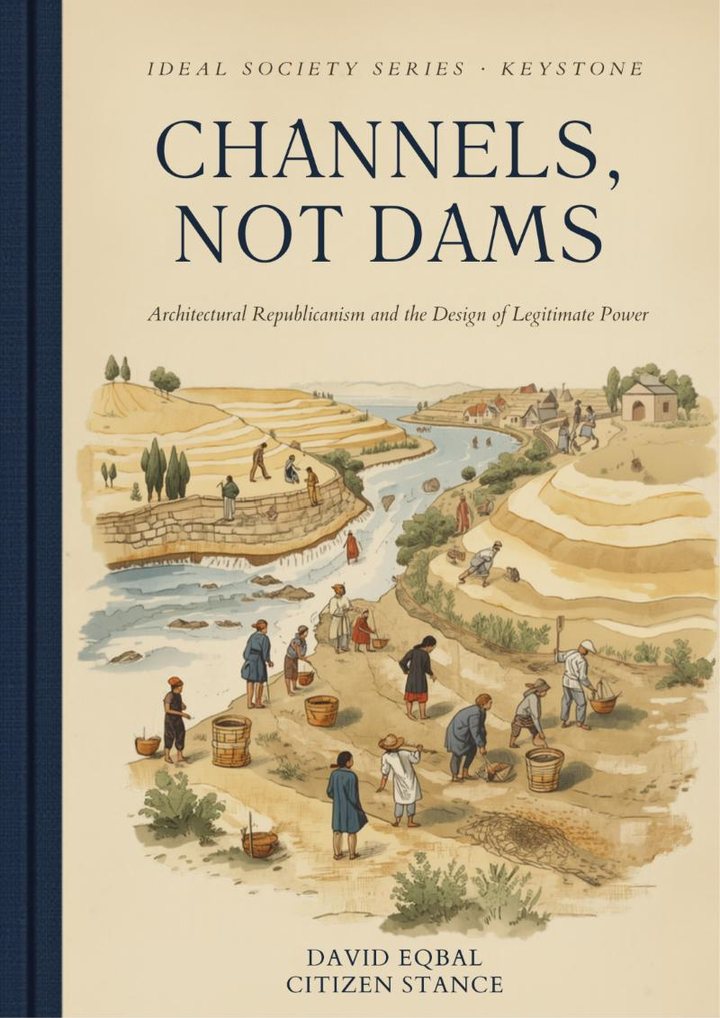
Channels, Not Dams
Architectural Republicanism and the Design of Legitimate Power
In plain words
Power that people simply trust tends to go wrong over time. This is not because leaders are bad people. Anyone with power and no checks will slowly start to use it for themselves. The paper argues that the answer is not better leaders but better design: rules that stay fair even when ordinary people are in charge. Its name for this idea is Architectural Republicanism, and it sums it up in one line: fair power is designed, not trusted.
What the paper is about
This is the "keystone" of the Ideal Society Series. Like the top stone of an arch, it holds the other papers together. The earlier papers looked at government, business, freedom and housing, and the same pattern kept showing up.
This paper sets out that pattern as five main ideas. The author is open that almost none of the parts are new. What he offers is how they fit together.
The problem
Thinkers in many times and places found that power held on trust does not stay trustworthy. The paper says three common answers fail:
- Make leaders good. This would have to work in every office and every generation.
- Forbid self-interest. This pushes it out of sight, and the enforcers gain the most power.
- Give up. This ignores systems that have kept power in check for centuries.
The paper takes a fourth path. It asks how rules should be shaped so that bad or ordinary leaders cannot do much harm.
The five main ideas
1. Channels, not dams
Self-interest is like water. In an old Chinese story, one engineer tried to dam a great flood and failed. His son dug channels and led the water safely to the sea. Good rules do the same: they give self-interest a path that helps everyone. But a channel may not dump its water on others, such as the next town, the next generation or the natural world.
2. The floor
"The floor" is a short list of things no decision may ever do to a person, however many people vote for it. It protects life, bodily safety, freedom from being owned, a voice that can be heard, and the means to survive.
The paper pictures the floor as a concrete slab. Human dignity is the concrete and the natural world is the steel inside it. Harm to nature crosses the floor when it cannot be undone. A creek buried in a pipe can be brought back to the surface. A 200-year-old tree cannot be replaced by anyone alive today.
3. Verified self-authorship
This means people should be the real authors of the rules they live under, and be able to check that for themselves. The key word is "verified." Rulers have often claimed to know what people "really" want. So the test must be one ordinary people can run, not one the people in charge simply approve. An expert may advise, but may set binding rules only through a process the public can check.
4. The four checks
Four tools that keep power honest, explained below.
5. The enabler
"The enabler" is the paper's name for the right role of an expert. A good expert helps people do what they want, safely. A bad one swaps their wishes for his or her own. This applies to doctors, judges, planners and funders, not only architects. Their authority is real, but borrowed.
The author gives a real case from his own work, with details changed. A man bought a run-down bungalow north of Toronto. He wanted a home for his family plus rental income, and the house was rebuilt around those wishes. But the zoning (the local rules for land use) allowed the two extra units only as rentals, never to be owned. The rules had decided who could own a home there before any drawing was made.
The four checks, explained
The paper claims that wherever power stays fair over time, four checks are working. Wherever a few people have taken over, at least one is missing.
| Check | What it means | How you know it is real |
|---|---|---|
| Independent review | Someone who does not depend on those in charge looks at what a rule costs the people it affects. | The reviewer has, at least once, found something those in charge did not want to hear. |
| Openness | The reasons and evidence are published in plain language before the decision. | People outside have used that material to question a decision. |
| A way to raise a problem | Anyone affected can report a harm the rule makers missed, and someone must answer. | A complaint has, at least once, changed the result. |
| Watching from below | The experience of the people who live under a rule goes on the public record. The paper calls this "monitoring from below." | The record includes views those in charge would not have chosen to publish. |
Based on the questions and signs in the paper's policy brief.
Two conditions
- Report to the public, not the boss. Many watchdogs in history, such as the inspectors of imperial China, reported only to the ruler. Ask: who does the check answer to?
- Check the checkers too. A watchdog that no one watches becomes a new place for power to hide. As an untested idea, the paper suggests a "ring," where each check watches another.
Real checks and checks on paper
A committee that exists, or a complaint line that is open, is only a check on paper. A real check has, at least once, cost its own organization something.
The author calls the four-checks claim an "informed conjecture," meaning an educated guess. The cases are few, and he built or worked inside two of them.
Eight objections
The paper tests itself against eight objections. It says it has answered two, such as the claim that the floor is just moral preaching. It has handled five others without fully solving them, such as the worry that those in power can fake the checks. One stays open: the worry that working with self-interest just helps the owners of wealth.
Why this matters to you
- Housing. The bungalow case shows how local rules can decide who may own a home and who may only rent. The paper's brief also notes that most new Ontario condos are sold before they are built. The buyers carry the price risk, and no check looks at their side.
- Decisions made about you. The four checks give you questions to ask any body that makes rules for you. Who reviews this? Are the reasons public? Where can I raise a problem? Is my experience on the record?
- Your voice. Being "consulted" is not enough. You should be able to check that your input counted.
- Experts in your life. Doctors, planners and other experts should serve your goals. If they override your wishes, the brief says the reasons should be public. You should also have a way to challenge them.
- The future. Rules should not push their costs onto the next generation. Harm that cannot be undone needs extra care.
What it proposes
The paper calls on anyone who writes rules, for a profession, a business, a funder, a council or a website, to:
- Dig the channel. Ask who it will spill onto.
- Lay the floor. No vote or majority may remove it.
- Make rules people can check. Those bound should be able to confirm the rule is theirs.
- Build in the four checks. Make them report to the people affected.
- Serve, if you are the expert. Keep your own preferences out of it.
It also sets out four claims that others can test, and invites evidence against them.
What the paper does not claim
It is not a dream of a perfect world, or a claim that the design is complete or easy to build. It is not rule by experts, and it is not against experts either. Four questions stay open. Who checks the checkers? Who speaks for people not yet born? Does a river have rights of its own? And why does the floor protect people who cannot take part, such as infants or the dying? The people in the paper's short stories are invented. The bungalow is a real job, told from the author's own account.
How to cite
Eqbal, David (2026). Channels, Not Dams: Architectural Republicanism and the Design of Legitimate Power. Citizen Stance / Position Citoyenne. SSRN. https://ssrn.com/abstract=7617458
This page is a summary. The full paper, with every source and the full answer to each objection, is free to read on SSRN.