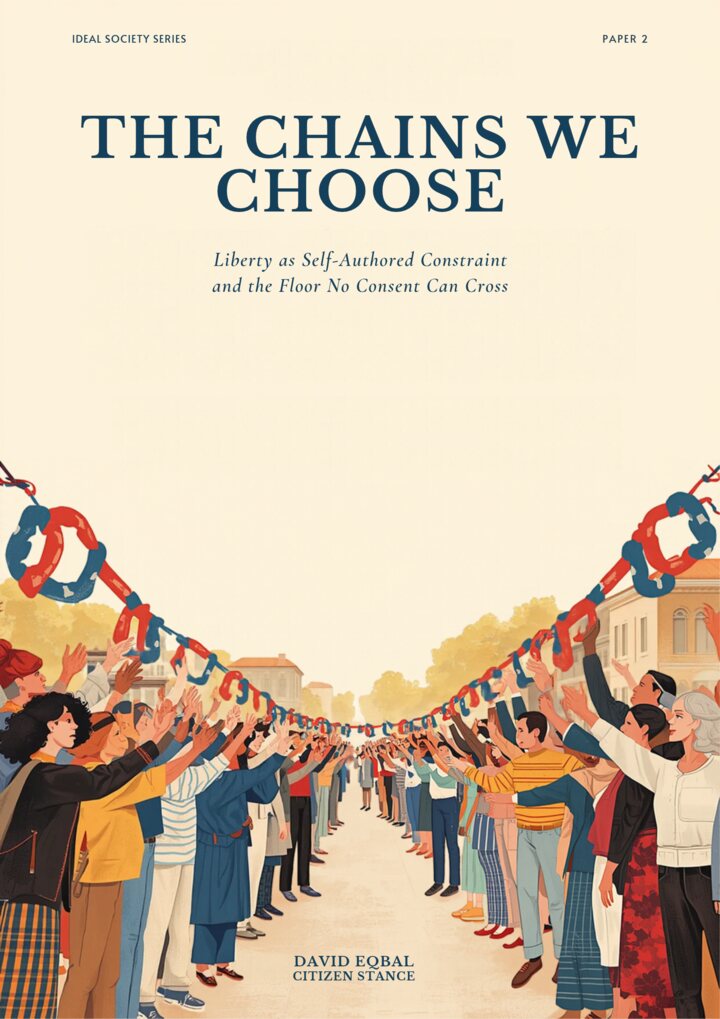
The Chains We Choose
Liberty as Self-Authored Constraint and the Floor No Consent Can Cross
Watch the video (13 min)
In plain words
Every law limits us in some way. The paper asks a simple question: when is a limit fair, and when is it just done to us? Its answer: a rule is fair when the people it binds truly helped make it. They must also be able to check that they did. Even then, there are some things no vote may ever do to a person. The paper's main example is Karim, an invented apricot farmer. He loses a fair town vote on water, and still feels the rule is his.
What the paper is about
An earlier paper in the series, An Ideal Society, named four "pillars" that a fair society needs. One of them was liberty, meaning freedom. The author admits it was the pillar he "understood least and defended worst." This paper tries to finish that work.
It starts from a line by Jean-Jacques Rousseau, a French thinker of the 1700s: "man is born free, and everywhere he is in chains." The paper reads this line as a question. All of us are bound by rules. Which of those rules can we call our own?
The argument
- Same rule, different feeling. Karim (invented) is 61, and his family has grown apricots for three generations. The town's water is running out, so it votes to cap how much each home may use. The cap will kill his trees. But the town writes down what it will cost him, publishes its reasons and hears him out. He loses. A woman in the next valley (also invented) gets the same cap as an order from a distant capital. The rule is the same. What differs is who wrote it.
- A self-authored constraint. This is the paper's key idea. It means a limit you had a real hand in making, alone or with others. Rousseau argued that obeying a law you helped make is itself a kind of freedom. So freedom is not the absence of rules. It is a test of whose rules they are.
- The danger: tyrants use the same words. Many cruel governments of the last century claimed to rule by the people's will. Isaiah Berlin, a British thinker, warned about this in 1958. A ruler who says "we are freeing you" steals the very words you would use to object. So the paper says self-authorship must be shown, not just claimed.
- The floor. "The floor" is a line no rule may cross, however many people vote for it. It protects dignity, meaning the basic worth of every person. The paper's example: a village that votes, with no tricks, to kill one of its members has committed "a murder with excellent process." International law already has such a floor. Bans on genocide, slavery and torture can never be lifted by any treaty or by consent (agreement). Karim's town may take his water, but never his life.
- Four checks make it real. How do you show that people truly wrote a rule? The paper uses four checks from earlier papers in the series. Someone independent weighs the cost to those bound. The reasons and evidence are public. People bound by the rule have a real way to raise a harm. And the experience of those living under the rule reaches the record, not just the view of those who wrote it.
- One system, not separate tests. An earlier draft treated these as separate tests. The paper corrects this. Self-authorship, the floor and the four checks work as one system. Take away any part and the rest breaks. The checks are how anyone notices that the floor has been crossed.
Real cases
- South Korea, 1987. Police tortured a student, Park Jong-chul, to death. Months later a police tear-gas canister killed another student, Lee Han-yeol, aged 20. Ordinary Koreans filled the streets, and within weeks the government agreed to direct presidential elections. The paper sees this as people claiming the right to write their own rules, at a terrible price.
- Switzerland. With 50,000 signatures in 100 days, citizens can force a national vote on almost any law. Voting is as routine as a utility bill. The limits include voter fatigue and campaign money.
- Taiwan. When Uber arrived, the government opened the question to vTaiwan, an online discussion process. A call for two-way ratings won 95% agreement across all sides. Audrey Tang, Taiwan's digital minister, described the bar as "all of the majority plus half of the minority." The limit: people who take part tend to be those already online and engaged.
- Estonia. It has used internet voting in national elections since 2005. Open questions remain, such as whether outsiders can check the system.
The hard case: the Swiss minaret vote
On November 29, 2009, Swiss voters banned new minarets, the towers of mosques. The ban passed with 57.5% of the vote. There was no fraud. Yet there were only four minarets in the whole country.
Switzerland had some 350,000 to 400,000 Muslims. Many were refugees from Kosovo, Albania and Bosnia. Many had survived ethnic cleansing in the 1990s.
The paper asks three questions. Did anyone independently weigh the cost to Muslims? Was the real effect made clear before the vote? Did the minority have a working way to be heard? Its answer is that the checks plainly did not reach them. So the vote was self-authored for the majority but imposed on the minority. A clean vote still crossed the floor.
It does not say every rule a majority puts on a minority fails. It says a majority vote alone cannot prove a rule is fair to the people it binds.
The same idea in many traditions
The paper argues that many cultures reached this same idea on their own: self-rule, with limits no vote may cross. Mencius, a thinker in ancient China, held that a people may remove a ruler who stops governing for their good. In Islamic tradition, shura means consultation as a check on rulers. Ubuntu, from Africa, says "I am because we are." The Haudenosaunee Great Law of Peace is a real system of government by agreement. The paper sees this pattern, among peoples who never copied each other, as its strongest evidence.
Why this matters to you
- Rules where you live. A water limit like Karim's can feel fair or unfair. The paper says the difference is not the rule itself. Were you truly part of making it?
- Losing a vote. No one wins every decision. The paper argues that you can lose and still call the rule yours, if your loss was looked at honestly and written down.
- Questions you can ask. Who weighed the cost to people like me? Are the reasons public? How can I raise a harm? Does my experience reach the record?
- Protection for minorities. No majority can vote away a person's basic worth.
- Showing up for others. Years later, the invented Karim sits through a town meeting that does not affect him. Someone sat through his.
What it proposes
The paper closes with "a call to builders." It speaks to lawmakers, to engineers who build voting tools, to reformers and to ordinary citizens. It suggests they:
- Give minorities a real channel to name a harm, on the record.
- Publish the reasoning, not just the verdict.
- Ask before a public vote whether the checks reach everyone the vote will bind.
- Write down the cost a choice will place on people, then decide with the truth on the table.
Its last line: "Build chains people can recognize as their own."
Limits and open questions
- The test helps a society ask the right question. It does not promise a clean answer every time.
- No country has built all the checks in full, not even the four in this paper.
- Berlin's warning is never fully answered. People in power could fake the checks. In the paper's words, "the machine that catches the counterfeit can itself be counterfeited."
- It offers "a real incomplete answer" rather than "a complete false one."
- Karim and the woman in the next valley are invented. The cases from Korea, Switzerland, Taiwan and Estonia are real.
How to cite
Eqbal, David (2026). The Chains We Choose: Liberty as Self-Authored Constraint and the Floor No Consent Can Cross. Citizen Stance / Position Citoyenne. SSRN. https://ssrn.com/abstract=7515298
This page is a summary. The full paper, with every source, is free to read on SSRN.