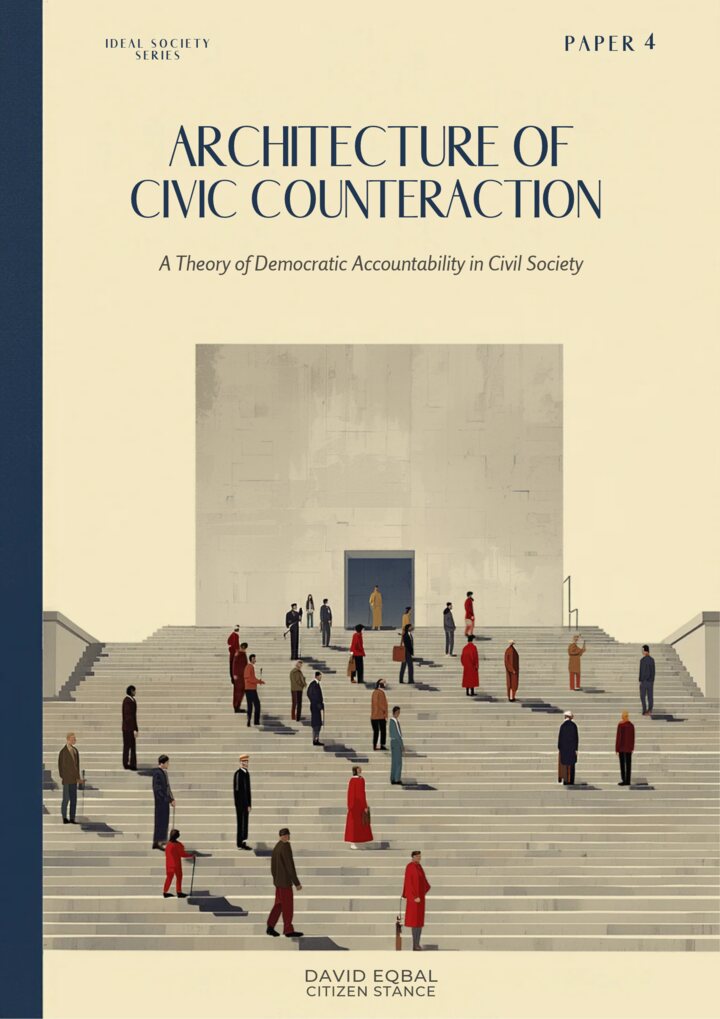
The Architecture of Civic Counteraction
A Theory of Democratic Accountability in Civil Society
In plain words
Think of waiting on a permit, a benefit claim or a call back from a government office. Between elections, there is no steady way for citizens to rate the public servants who make those decisions. The paper argues that this is a missing piece in how democracy was built, not a small crack. Cheap online tools now make it possible to add that piece: an ongoing public record of how citizens are treated. The paper uses Citizen Stance as its example of how this can be done.
What the paper is about
The paper is about accountability. It means citizens being able to judge and influence the public servants who hold power over their lives. The title's phrase "civic counteraction" points to its main idea: citizens, working from outside government, building a way to answer back.
Today, the tools for this are weak:
- Elections come every four or five years. They judge whole governments, not the people who handle your file.
- Ombudsmen are independent officers who look into complaints about government. They can make recommendations but cannot force action.
- Freedom of information requests, the formal way to ask for government records, are slow.
- News reporting comes and goes with the story of the day.
- Job reviews inside government are closed to the public.
The argument
Left out by design
The author's master's thesis at Dalhousie University looked at how buildings can shut older people out of community life. This happens through poor design, not hostility. The paper applies the same idea to public life. Citizens are left out because the system was never built to hear from them.
It is a one-way street. Governments keep detailed records on citizens, but citizens have no way to rate the people who serve them. People who cannot change outcomes stop taking part. Then that is used as proof that citizens do not care.
Three kinds of failure
- Corruption. Using public power for private gain.
- Incompetence. Not doing the job well, which shows up as slow permits, unhelpful caseworkers and unreturned calls.
- Unresponsiveness. No rule is broken, but "the citizen simply does not matter," as the paper puts it. This affects the most people and has the fewest fixes.
Reading government like a building
The author uses an architect's tools to look at government. The path for a citizen's complaint is blocked at almost every turn. Annual reports and consultations often look open without really being open, like a nice front on a building. Buildings are inspected throughout their life, but government has no regular check between elections. An ombudsman who cannot enforce findings is, in the paper's words, "a structural column that transfers no load": a pillar that holds nothing up.
The scale of the gap
The paper calls Canada well governed and does not argue otherwise. But it counts about 300,000 federal public servants, and more than one million across all levels of government. Every day they decide whether a permit is approved, a claim is processed or a call is returned. Almost none of these choices face ongoing public review.
There is also a built-in conflict. The people who could design better accountability are the same people it would rate. So change has to come from outside, and that takes tools.
Why now
Keeping a public record used to cost too much for any community group. Now it costs almost nothing. Sites like Yelp and Google Reviews show that rating by many people works. But no company will build a civic version, because there is no money in it. Those sites are also the wrong model: they reward extreme reviews and let the person reviewed say nothing back. A civic version needs set questions, confirmed reviewers, active moderation and a firm legal footing.
Case study: Citizen Stance
The author set up Citizen Stance / Position Citoyenne as a federal non-profit in December 2017. It is a registered charity. The paper explains each design choice:
- Non-profit. Its income never depends on stirring up outrage.
- A wide reach. Over 741,000 public servants at the federal, provincial and municipal levels are listed. This includes inspectors, caseworkers and permit officers, not only politicians.
- Confirmed reviewers. Reviewers sign in with a Google account. This makes dishonest reviews harder, but does not stop them.
- Careful moderation. Reviews that accuse someone of a crime are removed unless a court, regulator or official investigation has found it. Such claims have been the platform's biggest legal risk.
- Monthly report cards. Senior officials get a letter grade from A to F. The grade is 30% general standards and 70% standards for the specific job. Written reasons draw on public sources, such as Hansard (the official record of Parliament) and auditor general reports.
- Banks and insurers too. 81 federally regulated financial institutions are listed for review, because accountability should follow power over citizens.
- Safe reporting. An anonymous whistleblower channel lets people report serious wrongdoing. Each report is weighed with care before anything is published or passed on.
The paper is honest about early limits. Reviews are still few, public awareness is low, and income comes mostly from the founder and small donations. It presents the platform as proof that such a record can work within Canadian law.
Risks
- Lawsuits. A single defamation claim (a claim of harm to someone's reputation), even a weak one, could ruin a small non-profit. Laws against lawsuits meant to silence public criticism exist in some provinces, but not all.
- Gaming the system. Checks and human moderators help, but an open database "will always be partially gameable."
- Political pushback. This is mostly quiet, and could come from public servants and unions. The Charter's protection of free expression is a base, not a permanent promise.
- Media silence. Citizen Stance reached out to nine major Canadian media outlets. None replied.
- Systems not built for it. The charity struggled to open a business bank account. Grants and insurance are designed for larger groups. The paper calls this "a building code written for a building type that does not yet exist."
What it proposes: eight principles
- Law first. Know the rules on defamation, privacy and public figures before building anything.
- Stay independent. No elected official, party or government should help run it or fund much of it.
- Quality over size. A checked record of 100,000 people beats an unchecked one of a million.
- Use set questions. Written stories can add to them.
- Moderate in the open. Moderation should be active, recorded and follow published rules.
- Publish your methods and your limits.
- Build for the long term. Do not chase growth through controversy.
- Add to what exists. Courts, ombudsmen, auditors general and journalists keep their roles.
The paper sums up its remedy as "not a revolution, a retrofit." It means adding one missing piece: an ongoing, public record of citizens' experience with public servants.
Why this matters to you
- Everyday service. The paper argues that daily contacts, such as permits, claims and phone calls, shape your experience of government as much as laws do.
- A place to be heard. Right now, poor service usually leaves no public trace. A shared record would give your experience a place to count.
- Power beyond government. Banks and insurers also hold power over your life, so the paper says they should face review too.
Limits and open questions
The paper presents Citizen Stance as one attempt, in one country, and calls it incomplete. Reviews are still few compared with the size of the database. Cheating can be reduced but not removed. A single lawsuit could hurt a small group far more than it could bear. The legal protections it relies on could also change. Only a long record, built over years, could show whether this kind of pressure leads to real change.
How to cite
Eqbal, David (2026). The Architecture of Civic Counteraction: A Theory of Democratic Accountability in Civil Society. Citizen Stance / Position Citoyenne. SSRN. https://ssrn.com/abstract=7438878
This page is a summary. The full paper, with every source, is free to read on SSRN.